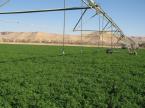
How conserving water won over agricultural production
Saudi Arabia dreams of food security
Le Monde diplomatique / English edition
March 2009
by Alain Gresh
The date-processing factories all along the desert road from Riyadh to Al-Kharj are a reminder that Saudi Arabia is the world¹s biggest producer of dates. On the outskirts of Al-Kharj a large sign announces the Prince Sultan air base where, famously, US troops were stationed until 2003. A few kilometres further on, the road forks and you come to a well-guarded gate with a sign above it saying ³Al-Safi ¬ the world¹s largest integrated dairy farm². Here, the car is disinfected and cleared to continue on its way. In the plant¹s reception area a photocopied page from the 1998 Guinness Book of Records giving its vital statistics is on display: then, it had 24,000 cows and covered 3,500 hectares. Now there are 37,000 head of cattle: black and white Holsteins, originally imported from Canada, which are artificially inseminated. The male calves are killed for meat and the females go into milk production.
Adapting dairy farming to Saudi Arabia¹s climate hasn¹t been easy. Refrigeration units are needed to maintain a temperature below 27C in the cowsheds and mobile sunscreens protect the animals from the scorching heat. Milking is automated and computer-controlled. On the same site is the dairy processing plant, which is also automated. It¹s run by the French companyDanone, a partner in the project since 2001. The farm produces 220m litres of milk per annum, which supplies one-third of the country¹s needs.
The Al Safi company was the brainchild of a visionary who died two years
ago, Prince Abdullah Al Faisal, the older brother of the present foreign
minister. One of the prince¹s proposed schemes was to tow icebergs from the
North Pole to satisfy the country¹s water requirements. He also wanted to
make the country self-sufficient in milk. Karim Mansour, Al Safi-Danone¹s
young director, explained: ³We get very high yields: a daily average of 33
litres per head, which is above the international average. We have 30,000
sales outlets, 25 distribution centres in Saudi Arabia and five in the Gulf,
a branch in Jordan and another in Yemen, and we have plans for Lebanon and
Syria. Two-and-a-half thousand people work here [plus another thousand at
the farm in which Danone is not a partner]. One-quarter of the staff are
Indian and one-quarter Saudi. Employing Saudis has been a challenge: it¹s
hard to find nationals to do manual jobs, but we make an effort to find them
in poor regions such as the south and the east.²
A plume of steam drifts from a wooden hut where water is being pumped from
underground at a temperature of 70C. Originally it was drawn from a depth of
200m, but now it has to come from 2,000m below ground. By way of
justification, Mansour says: ³We used to grow our forage here, but we¹ve
moved to fields 200 kilometres away so as not to exhaust the water table. We
also have a water recycling policy.² And he assures me that animal husbandry
only uses 3-4% of the country¹s water supply, whereas arable cultivation
consumes more than 80%.
Attaining self-sufficiency
Few people are aware that Saudi Arabia transformed itself in the 1980s into
a significant wheat producer. The government guaranteed farmers a purchase
price higher than the world market price and the country became
self-sufficient in 1984. The area under arable cultivation rose from 67,000
hectares in 1980 to 907,000 in 1992 and yields improved from 2.12 tonnes per
hectare in 1980 to 4.7 by 1988 and then 5.19 in 2005. (In comparison, the
average yield in France is 6.98, in China 4.22 and in Austria 5.03.) Private
companies were set up and made hefty profits. Peak production was reached in
1993 (5.3m tonnes), enabling the country to export more than 2m tonnes. At
the time, the UN¹s Food and Agriculture Organisation congratulated the
country on its performance.
The desert kingdom is not all arid land and has, especially in the north and
the south, green and fertile areas, but wheat production on this scale
required tens of thousands of hectares to be reclaimed from the desert. To
understand the logic of this, you have to go back to the 1970s and the
petrol boom that came after 1973. Then, the third world dreamed of a new
international economic order and the West threatened to use food as a weapon
by cutting off wheat and milk exports to states it deemed hostile. A number
of governments, including ones which were not of a progressive nature,
declared a desire to achieve national food security. Saudi Arabia was one of
them. Official brochures from that time express that desire in language
similar to that of ³socialist² Algeria. Vast oil revenues seemed to open all
sorts of doors, including one leading to massive milk production.
³We¹ve become the main water exporter in the region,² explained an
agricultural engineer who wanted to remain anonymous. ³We¹re producing
wheat, fruit and vegetables, which we sell to our neighbours and which is
using up our water resources.² Along with his fellow professionals, he¹s
been trying to draw this to the attention of the authorities. There¹s been a
heated debate between advocates of food security and those who want to
conserve the country¹s water supply. In the end, as far as wheat is
concerned, it was the water-conservers who won. The government decided on a
progressive scaling-down of wheat production subsidies and they will be
phased out altogether between now and 2016. This year, for the first time in
25 years, Saudi Arabia will buy 300,000 tonnes of wheat on the international
market.
Unlike many politicians, the Saudi deputy minister for agriculture, Dr
Abdullah al-Obeid, doesn¹t mince his words. He was a member of the
delegation that negotiated his country¹s membership of the World Trade
Organisation, which Saudi Arabia joined in 2005. He told me: ³At the
ministry, we thought we should maintain our wheat production. We were
achieving high yields, especially in the north, of eight to 10 tonnes per
hectare, and there we have less of a problem with water. We would like to
have kept production in the north.²
Turki Faisal al-Rasheed is president of Golden Grass Inc., a major Saudi agricultural company. While he was at prayer, I looked at the articles and press releases in the company¹s press book. He was an observer of the recent Kuwaiti elections and is an advocate of a parliamentary system for his own country. He shares al-Obeid¹s reservations: ³ All countries have water problems, even the US. But we have to go on growing. That allows us to help poor rural areas and also helps us to master up-to-date agricultural technologies, which saves water. It would have been better to link subsidies to the use of Saudi labour.² A number of businessmen who lost out with the withdrawal of wheat subsidies boycotted the agricultural trade fair last November.
Food security continues to preoccupy Saudi officials. ³The food crisis in
the spring of 2008 was a warning sign,² according to al-Obeid. Saudi Arabia
is a net importer of agricultural products, especially rice, corn and soya.
This fact is pushing the state to invest overseas. We¹ve sent government and
private-sector delegations to Turkey, Ukraine, Egypt, Sudan, Thailand, the
Philippines, Vietnam, Ethiopia and Uzbekistan. These delegations have been
very warmly received.² He rejects the suggestion that this is a
neo-colonialist venture, and deplores the lurid fantasies of the
international press: ³We want to invest in agriculture abroad, but we don¹t
want to monopolise the entire output for ourselves. Quite the reverse: we
plan to expand the total area under cultivation and guarantee that a
proportion of the harvest will stay in the producer country.²
Fears of massive investment by the Arab world in the agriculture of the
South have been front-page news in recent months. A ³rush for arable land²
was how Le Monde put it (13 December 2008). The paper published a map
produced by the NGO Grain (grain.org), which claimed that Saudi Arabia, for
example, had bought up precisely 1,610,117 hectares. ³States which are
grabbing agricultural land in Africa² were denounced by the site Afrik.com
on 12 December. ³Getting their mitts on agricultural land in the South² was
how a schoolteacher explained it to his students on his blog.
³There¹s been a lot of talk about investment in Sudan,² al-Rasheed concedes.
He himself has written several articles about it in the local press. ³Sudan
has a number of attractions: it has a huge area of cultivatable land, only
20% of which is currently being used. It has water in abundance from rain
and the Nile. And it has a favourable climate.² Even back in the 1970s Sudan
was being touted as the breadbasket of the Arab world. ³And yet,² according
to al-Rasheed, ³there are numerous obstacles: in addition to the poverty of
Sudanese agriculture, its artisanal character and technical backwardness,
there is no clear system of land ownership. And the land proposed for
cultivation is in petroleum regions and so is vulnerable to future
take-over. Infrastructure in the country is rudimentary. When all of that
has been sorted out ¬ and it¹s mainly the responsibility of the authorities
in Khartoum ¬ then we can invest. But it¹s not just around the corner.² The
other Eldorado which is often cited, Egypt, presents similar problems,
according to al-Rasheed. And Asia is simply too far away.
A western presence
Overseas private investment in agriculture is nothing new. Western nations
have had a presence in their former colonies for several hundred years and
the situation didn¹t change very much when those colonies gained
independence. The price rises in agricultural products in 2008, though
short-lived, have probably increased the desire. But conception is one thing
and execution another ¬ and it is a bit rich to denounce the Gulf states for
harbouring colonial ambitions towards the world¹s agricultural land. All the
more so, as private investors who grow rice or wheat are unlikely to keep it
for their home country; they¹ll want to sell it on the world market to the
highest bidder.
The NGO Grain has produced a list of agricultural investment projects for
2008 arranged by country. When it comes to Saudi Arabia and the Gulf states,
it¹s nearly always a case of plans, visits and intentions rather than signed
contracts. Even the agreement quoted as a done deal between the Saudi Bin
Laden group and Indonesia ($4.3bn to develop half a million hectares of
basmati rice, which Saudi consumers are especially fond of) seems still to
be at the planning stage. And the financial crisis, added to the reduction
of agricultural prices (even if only temporary), will also limit many
potential investors¹ appetites.
With a rapidly growing population and ground water that is either running out or becoming polluted ¬ a detailed picture of the country¹s water resources has yet to be made ¬ plans to rationalise the construction of new desalination plants will not be enough to cater for the country¹s future water needs. No one is talking about hauling icebergs from the North Pole any more, so Saudi Arabia needs to find new ways of guaranteeing its food security.
Translated by George Miller
More from Alain Gresh
© Le Monde diplomatique – all right reserved
Modify this article (5280) Recalculate this page *