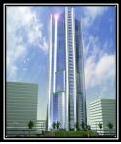
Real estate towering in KSA
Sunday, 10 February 2008
With both international and domestic investments flowing into Saudi Arabia’s real estate market, it is quickly changing the skyline of the Kingdom’s cities. A MONEYworks, report from Riyadh.
A group of investors from the GCC have launched a new Saudi real estate firm called Ensaan International Housing Company. Capitalised at US$107 million, the company plans to build housing complexes in various parts of Saudi Arabia.
Kalos Construction Co. Ltd is another example of rising international investor interest in Saudi Arabia’s burgeoning real estate development. Jun-ki Cho, an engineer and the South Korean company’s manager in charge of construction at the Saudi office, says that he and his team have just arrived to begin what could be a long and profitable stay.
He adds: “We’re upbeat about Saudi’s real estate industry, the reason why we are here.”
Cho rightly describes the mood in the Kingdom. In fact, experts are saying that now more than ever – since the boom in the 1970s – is the time to invest in the Saudi real estate industry. According to official statistics, the Kingdom’s real estate industry will need to invest more than SAR100 billion annually to achieve the ambitious plans laid out by various parties.
The total cost of all projects currently underway or in advanced planning in Saudi Arabia over the next several years is about SAR1.06 trillion, according to Samba Financial Group’s recently released mid-year report. The oil and gas industry alone accounts for SAR259 billion, or one-fourth, of the total.
Poised to cash in are real estate agents, investors and businessmen in related fields, as well as property developers such as Riyadh-based Saudi Hotels & Resort Company, Saudi Real Estate Company, A.M. Bin Saedan Real Estate & Sons, Dar Al Arkan, Jadawel International and many others, including foreign companies like Dubai-based Oula Development Company.
Construction activities
If one travels through the key cities of Riyadh, Jeddah, Dammam, Alkhobar, Makkah and Madina, the amount of construction work cannot escape one’s attention. It begins with construction of new roads and landscaping; there are also tall office and residential towers under construction, while newly-completed gleaming malls, sprawling shopping centres and hypermarkets are drastically changing the backdrop of these cities. In many instances, old buildings have been or are being pulled down to give way to new developments.
Even in the Kingdom’s far-flung areas like Hafr Al-Batin, some 400-450 kilometres north of Riyadh, massive housing construction projects are coming up. Wide spaces are visible all over that have been subdivided into plots for houses.
Some of the most hectic activities taking place right now are in Makkah and Madinah, where high rises are being constructed to accommodate the projected 30 million visitors to these cities by 2010. Houses, apartments and shopping malls are rising rapidly, particularly around the Grand Mosque. The largest of these projects include Al Oula Development Corporation’s US$3 billion Al-Shamiya, which is designed to accommodate up to 250,000 people on completion by 2016, the US$8 billion Abraj Al Beit project, which is scheduled for completion this year, and the US$2.7 billion Jebel Omar Development.
One of the latest projects to be announced for Makkah is the SAR6 billion Rawabi Abraj Al Bait project, a 21-tower residential and commercial development. The prestigious project, which overlooks the Masjid Al Haram, one of the holiest sites of Islam, is in fact larger in scale than the adjacent Abraj Al Bait project, covering a total area of 2.7 million square metres and boasting world-class amenities including wireless connectivity, 24/7 security, high speed elevators, restaurants, ample parking areas, medical facilities, prayer rooms and shopping malls.
Another large project is Ajyad, a modern residential city comprising shopping malls and hotel towers designed to service pilgrims as well as hospitals and schools. The project is estimated to cover an area of 350,000 square metres and aims to preserve the historical identity of the holy city through creating six museums that feature the history of Islam.
The Custodian of the Two Holy Mosques, King Abdullah, also recently approved the expansion of the northern areas of the Grand Mosque in Makkah. The expansion includes the addition of a 380-metre courtyard, additional pedestrian tunnels and a service station. Buildings existing on the north and northwest of the Grand Mosque would be expropriated. An amount of SAR6 billion has been allocated for compensating the owners.
In recent years, the Kingdom has spent more than SAR70 billion on the expansion of the Two Holy Mosques. The expansion of Safa and Marwa was completed this Haj.
A new expansion is also being carried out at the Prophet’s Mosque in Madinah at a cost of US$4 billion. It includes construction of sunshades around the mosque, expansion of the mosque’s eastern courtyard and establishment of a new transport station and parking areas.
In the Eastern Province, the Abdul Mohsen Al-Hokair Group, a major player in the real estate sector, has also nearly completed four towers designed to house large administrative offices and headquarters of international standard in the Eastern Province. Known as a Novotel Business Park, it will include a five-star hotel to cater to both domestic and international businessmen and tourists visiting the region. Forty per cent of the towers have already been booked by international companies working in the fields of oil, energy, water, electricity and contracting, in addition to banks and real estate firms.
Foreign firms have likewise shown confidence in the Saudi real estate market. An example is Dubai-based Emaar Properties. It will develop the King Abdullah Economic City, while Jafza International, the global free zone operations arm of Economic Zones World, also recently signed an MoU with Saudi Arabia’s Rakisa Holding for the development of Rakisa Economic City in Hail, Saudi Arabia.
The Rakisa Economic City, a SAR30 billion (Dh29.5 billion) project spread over 15,600 hectares, is envisaged to be the second largest economic zone in the country, incorporating an airport, dry port, railway station, agricultural industries and services, an entertainment area, mining centre, business centre, knowledge area and residential complexes.
Financing these projects is not a problem as of now. Moreover, lenders are not concerned with the credit crunch in the west, as the market has ample liquidity. Aside from the government that grants housing and related loans, banks are happy to lend money, optimistic as they are about the prospects of the local real estate industry.
Mortgage finance is also expected to grow significantly, boosted by the construction and development frenzy that will be seen in the residential and commercial property markets. The Saudi mortgage market is less than two per cent of GDP today, compared to 78 per cent in the UK and over 70 per cent in the US. In fact, the cause of mortgage finance got a shot in the arm last January when Euromoney organised a home finance event at the Four Seasons Hotel in Riyadh. The conference presented by Dar Al Arkan, along with Euromoney, aimed at showing how housing could be made affordable for ordinary Saudi citizens.
Six new cities
The Kingdom’s real estate development has seen a tremendous boost with the announcement of six mega cities to be constructed in Rabigh (King Abdullah Economic City), Madina (Knowledge City), Hail (Prince Abdulaziz bin Musaad Economic City), Jizan, Tabuk and the Eastern Province.
These city projects will together contribute US$150 billion to the Kingdom’s GDP by 2020 and will provide job opportunities to 2.1 million people. The per capita GDP will consequently increase to US$33,500 from US$13,000, according to the Saudi Arabian General Investment Authority.
Work on the Knowledge Economic City in Jeddah is expected to start early this year. The city will be developed in three phases, with each phase expected to take about four years to complete. The project has attracted considerable international interests, with the project’s main developer, Seera City Real Estate Development, having already signed an MoU with Malaysian companies such as Multimedia Development Corporation. Siraj Capital Limited and Project Development Company have signed a US$100 million MoU to develop the project’s hospitality sector, including the construction of hotels, residential apartments and an exhibition and convention centre.
What fuels the boom?
Saudi Arabia’s current boom in the real estate sector has been fuelled by a number of factors.
Says Turki Faisal Al-Rasheed, CEO of Golden Grass, Inc. (GGI), a Riyadh-based company involved in contracting and other business lines: “These factors include the high price of oil that reached US$100 per barrel recently, big spending budgets in the last three years and the increase in Saudi population.”
According to the ministry of planning and national economy, the Saudi birth rate, which stands at three per cent per annum, is the highest in the region.
The current population, the ministry says, stands at 27.7 million. This is expected to grow by six per cent by 2015. The population projection for 2025 is 34.8 million and 45 million by 2050.
Early last year, the population was estimated to be 22 million. Of that number, 17 million were Saudis, of whom only 22 per cent had their own homes.
Research and field studies show that by 2020, the Kingdom will need four to five million housing units. To meet this demand, it is estimated that around SAR117 billion is required for investment annually in the real estate sector.
In order to build these houses and apartments, approximately 110 million square metres of suitable land will be required. The cost of this alone will be around SAR10 billion.
“A city like Riyadh, for example, will need 70,000 housing units annually or about 200 housing units per day,” says Hamad Biladi, a real estate agent.
Land prices are also rising rapidly, given the growing demand. A piece of land in the capital city was recently sold for a whopping SAR50,000 per square metre.
“Demand for land is also increasing as citizens aspire for their own homes and thus move out of rented homes,” says Biladi.
He also adds that global demand for real estate is expected to remain strong for at least a decade, especially in Latin American countries, China, Japan and India. This, he explains, contributes positively to the already unprecedented surge in optimism in Saudi real estate market.
Significantly, between 2000 and 2005, the local real estate sector achieved a growth in fixed capital of up to 40 per cent.
But it is not just the rising population that is fuelling this demand. Says Sheikh Al Dugaither, chairman of the Alkhobar-based Amaleed Trading Establishment, which has been developing the Al Dugaither Tourism Island: “Demand for houses in the Kingdom will go up significantly not only due to our growing population, but also because of our increasing purchasing power.”
While Al Dugaither is right about the rising liquidity in the hands of Saudi citizens, the other aspect that is fuelling the demand is their growing aspiration to own properties and be part of the modernising cityscape.
Of course, one factor that needs more attention right now is the creation of proper regulatory infrastructure to support the demand and the flow of liquidity into the sector from both domestic and international investors. Although investors are by and large sure about the opportunity to make profits in the Kingdom’s real estate investments, they are still unsure about the course and timeline of the regulatory regime as it takes shape.
Early last year, the Shoura Coura Council announced that it will create a government organisation similar to the Supreme Commission of Tourism to solve the problems faced by the real estate industry. When that happens, it will help to accelerate the pace of activity and give real estate investing in the Kingdom a more mature direction.