Sources of Tension in Afghanistan & Pakistan: A Regional Perspective
Round table seminar on ‘Exploring Iran and Saudi Arabia’s interests in Afghanistan and Pakistan: Stakeholders or Spoilers – A Zero Sum Game?’
Background to the event
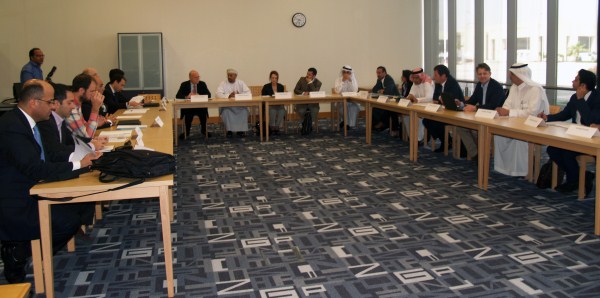
Dr Turki Faisal Al Rasheed was recently invited to participate in a round table discussion on ‘ Exploring Iran and Saudi Arabia’s interests in Afghanistan and Pakistan: Stakeholders or Spoilers – A Zero Sum Game?’ The event was co-hosted by the Barcelona Centre for International Affairs (CIDOB) and Qatar University and was held in the University’s New Library in Doha. A number of influential and knowledgeable professionals were in attendance, whose expertise covered a range of relevant areas from international relations and conflict resolution to economics and politics.


The aim of the CIDOB policy research project ‘Sources of Tension in Afghanistan and Pakistan: A Regional Perspective’ is to explore the main sources of tension in the two regions, together with other countries’ roles in relation to these tensions. The purpose of the roundtable event was to explore the issues and challenges facing Iran and Saudi Arabia in relation to the stability of Afghanistan and Pakistan, especially once troops are withdrawn from the former in 2014.
Dr Rasheed’s remarks
Preface
Dr Rasheed stated that he came to the table with a ‘farmer’s’ perspective – although his experience in the political and economic arenas must also be acknowledged. He prefaced his comments with a metaphor relating to sowing, growing and harvesting a good crop and asked how that applied to Afghanistan and Pakistan. He posed another question: “Are we still operating under the beliefs of John Foster Dulles?” – referring to the usefulness of Pakistan’s army to USA strategic interests.
Main body of remarks
Dr Rasheed made two main points:
-
Internationally: most stakeholders’ involvement in Afghanistan and Pakistan is to use the two countries for their own purposes, which is not necessarily in Afghanistan and Pakistan’s best interests;
-
Locally: in the Middle East, all political movement is seen as rivalry.
He elaborated on the first point by charting the long-term distrust and disenchantment between Pakistan and the USA, and Pakistan’s more recent reaching-out to Iran and China, in defiance of the USA’s wishes. He concluded this point by musing whether, if the USA/Pakistan alliance ended, Pakistan might be able to discover whether its regional policy objective of competing with India was attainable without USA support, and wondering if the USA and Pakistan should admit that, in its current incarnation, their relationship was over, and move on to develop a new one.
Dr Rasheed went on to outline the USA’s recent decline, both strategically and financially. He highlighted their foreign policy tactics against Russia, Afghanistan, and Islamic extremism, and then quoted statistical data showing the recent decline in the USA’s economy, indicating that they would not be able to maintain their position in the region because of their financial and economic problems.
With regard to the second point, Dr Rasheed turned his attention to Saudi Arabia and Iran, summarising the political, economic, military, and social advantages and disadvantages of each vis-à-vis the other. He noted that the two countries have strong extra-regional and intra-regional allies. Iran’s other advantages are its advanced military capabilities and its close relations with various sectarian social and political movements in the region; its main disadvantage is its limited economic capabilities. Saudi Arabia also gains legitimacy from its presence on the international stage, and its vast financial resources and global religious social network. However, Saudi Arabia’s extra-regional ally is also the cause of its main disadvantage: the country’s close relationship with the USA leads to questions regarding its political actions; and Dr Rasheed stressed that Saudi Arabia must be careful not to be led into any conflict with Iran. He ended by stating that security and stability in the region can only be ensured by the adoption of social, economic and political reforms.
Recommendations
At the end of his remarks, Dr Rasheed made the following recommendations with regard to the necessary approach to take in the region:
1- All stakeholders, especially the western countries, should end their thoughts of colonialism and stop acting in unethical ways in the region. Further, they should not adopt policies of keeping the Gulf countries and Arab world weak and insecure to maintain the USA’s dominance.
2- Concentrate on sustainable development: world leaders, individuals, government and private organisations and NGOs should get together to try to meet the goal of world-wide sustainable development in a manner similar to the UN’s Millennium Development Goals programme, which has mobilised governments and business leaders to donate billions of dollars, cutting in half the amount of extreme poverty worldwide in just a few years.
3- Focus on new challenges:
-
a. The pressure of a worsening environment, which is affecting the livelihoods of
-
hundreds of millions of people;
-
b. The growing number of middle-income countries with tremendous internal poverty;
c. The rapid spread of non-communicable diseases.
For further information relating to this seminar , see
http://www.cidob.org/es/temas_regiones/asia/sources_of_tension_in_afghanistan_paki
stan_regional_perspectives. For information about the work of the CIDOB in general, please refer to their website at www.cidob.org/en.
Dr Rasheed’s website is at www.tfrasheed.org/e/.